On the road
Notes from the drift.

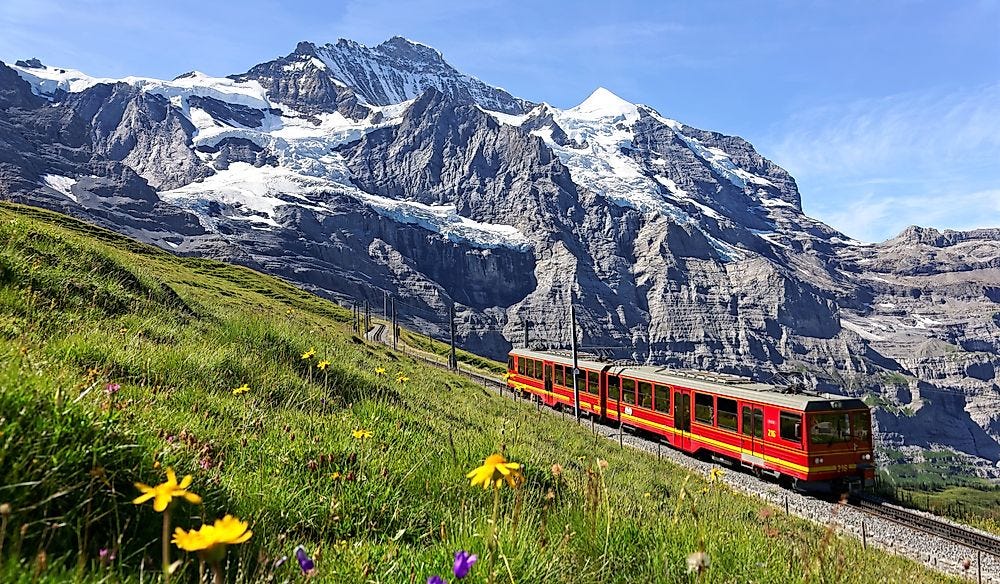
Davos, Switzerland, 1964
I was a school-boy of fourteen, in what would turn out to be the last summer of my childhood. A year later I’d be out of school, heading for dead-end work.
I don’t know how my parents paid for the trip. They didn’t have much money at the time, but they did cough up the necessary amount, somehow. I didn’t think about how they did it. My friends were going, and so I had to go, too. I filled out the form for a passport, had my dad sign it, and had my picture taken at Mr. Peabody’s photograph shop. I waited impatiently for the middle of June, when I was finally off with my mates: Johnny Frear, Barry Welch, Johnny Folkes, and others whose fresh faces I can still see but whose names I have lost.
We met early one morning at the train station in Leicester and took an express to London. The journey unfolded in increasingly exciting stages: the tube to Waterloo, the train to Dover, the cross-channel ferry boat to Calais, the Orient-express to Basle, the rattling little Swiss train to Davos. And as I looked out the window on each leg of the journey, more and more I entered a world stripped of familiar sites, signs, and understandings. I loved it. Something entered me in the journey. My first trip abroad. Or I entered something I will call the world. By the time we stepped down from the carriage onto the gravel by the side of the track in Davos, and as we joked around and pushed each other as boys do, I knew I never ever wanted to go back to the life I’d lived up til now, and most of me didn’t go back.
Bruce Peninsula, Canada, 1995
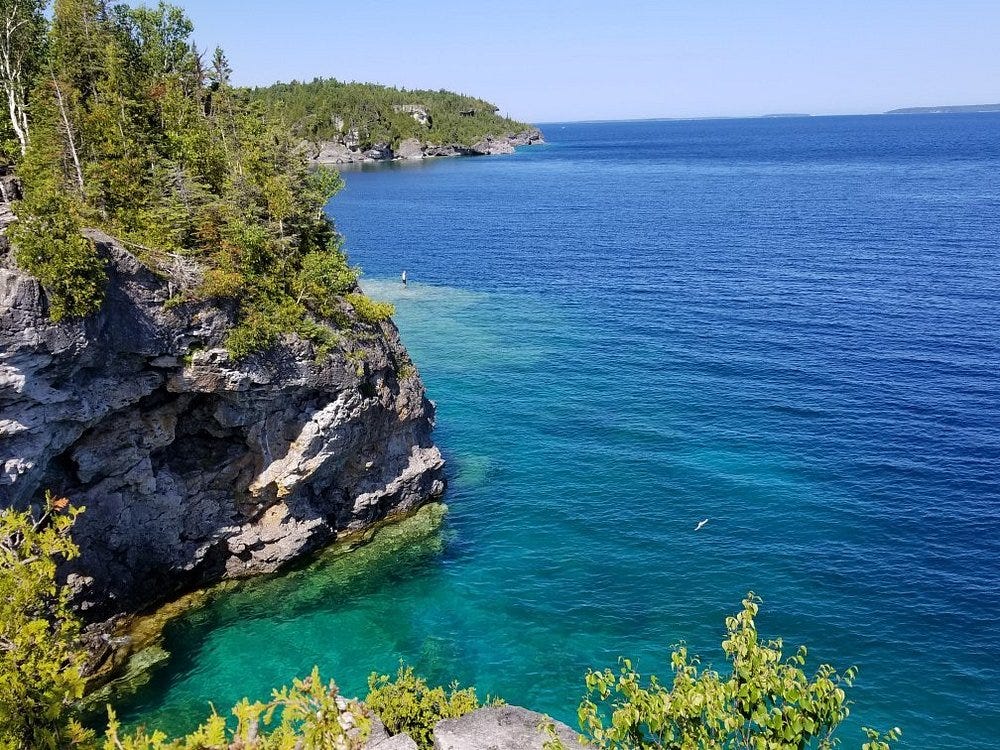
At the information center, a sign says that 12,000 years ago the spot I am standing on was buried by the last ice age. It scraped right across here, hundreds of feet thick. I suppose, in a way, it’s a form of disaster tourism, where you imagine yourself watching an ice age advance. Two pairs of long underwear? Three pairs of socks? I noticed how notched and carved all the rocks around me were. According to a leaflet at the center, if a child from 40,000 years ago was transported to now and was brought up in a contemporary family, you couldn’t tell the difference between that child and today’s kids. I think the point they were stressing was we humans hadn’t changed but the weather had. I think we were supposed to imagine ourselves 40,000 years ago. We’d be looking at the same rocks.
It took a long time to get food at the Grand View restaurant on my first night in the area. While we were waiting, it was suggested, again, in the menu, we think about geological time. Does that slow down hunger? It does not. If you are not waiting to eat, you might be interested to know, it took it took four-hundred million years form the view from Tobermory Bay. You might also be interested to know there was more time between the Silurian and the Jurassic eras than between the Jurassic period and now. According to the menu, the Silurian age was so long ago that north was in the east and the table I was sitting at was 10 degrees south of the equator. In that case, I wouldn’t actually be sitting here. I’d be swimming off a vast coral reef, where maybe I would hear about the specials.
San Miguel de Alllende, Mexico, 2001

There is a secret garden where I’m staying, vibrating beyond human perception. It’s a realm of ultrasounds, ultraviolet light, high radio waves, and low radio waves. It sends out sights, smells, and sounds our sense organs are too dim to detect. Is it beautiful? We can imagine it is.
My host tells a story of the gauchos who come to town to drink themselves sick on bad tequila in the tavern a few doors down. Can there be bad tequila, or only too much? Each day, we walk by the swinging doors of this dark tavern, on our way to the town square. The smell is sometimes beer, sometimes disinfectant, sometimes unfamiliar and unpleasant.
One night, or maybe more than one night, the last gaucho to leave the tavern could not find his horse. He was asleep across the narrow cobbled street, his body in the road and his head on a cold hard pillow of cobbled stone. Later that night, a taxi driver could not get by the gaucho’s inert body. He halted the cab, got out, moved the gaucho’s legs close to the gutter, returned to his cab, and slowly drove around him. Then he stopped the cab again and gently returned the gaucho to his original position. I thought there was a little of me in the gaucho. I hoped there was a little of me in the the cab driver, too.
England, 2007
Laurie and I are sitting with my parents over another cup of tea when she suggests I read a passage from my notebook to them, and then she will do the same. You may think this is funny. It is, if you think a horror movie is funny.
My parents go to the kitchen for more biscuits and tea. I tell Laurie that in my entire life of doing whatever I’ve done, Mum and Dad have never expressed interest in hearing a single story, article, book chapter, or poem I’ve written. They’ve never asked to listen to a single piece of music I’ve been involved in. They’ve never asked me what my master’s thesis was about or, fifteen years later, the subject of my Ph.D. research. They know it had something to do with museum studies, whatever that is to them. I became interested in museums, I think, because, starting from the time I was a baby, my parents took me to museums, really hundreds of them, we were right there, the whole family. Never once have they asked what I think about them. We are a talky family, but this not the sort of talking we do. I tell Laurie this is not going to happen. There will be no sharing, no guerrilla theater. Perhaps, I’m thinking now, I was a bit overly sensitive. Perhap, I’m thinking now, my parents felt insecure about the ways my life had traveled away from theirs.
We escape from family for a few days. We’re in an internet café in Bowness-on-Windermere with hippy décor that could place it anywhere from san Francisco to New Dehli. Whatever happened to internet cafés? I didn’t notice when they disappeared. We visit Dove Cottage, where Wordsworth lived, near Grasmere. The tourists here are more middle class, educated, and continental European than the crowds around Bowness. I buy the CD of Ian McKellen reciting “The Prelude.” We listen to it in the car. It’s beautiful, including Ian’s affected Cumbrian accent mixed with his RADA voice, in which every word and syllable are enunciated clearly, even peppered with regionalisms.
We’re on the way to Keswick, an odd choice given that I went there with my second and third wives on consecutive honeymoons. I don’t think that’s symbolic. I say to Laurie, “It’s just an interesting town.” It has a great neolithic stone circle up on the hillside, a short drive from our hotel. It has Ruskin Point, that most Ruskinesque view of Lake Derwent. We visit all the places I have visited before.
I have a cold. It’s a spell I fall under whenever I visit England. Laurie thinks it points to what she calls my compromised immune system. I prefer to see it as my attempt to allow everything to enter me while I’m here. I do allow it all. Also, I can’t wait to go home.
___________________________
THE DIFFERENCE BETWEEN MEMORY AND STORY. The next Zoom conversation on Saturday May 30 from 3 to 4 EST. To RSVP: lauriestone@substack.com
Here’s a little teaser for the conversation by Laurie:
“Here is a trick. If you want to create the illusion of intimacy between you and the reader, write like you’re talking to someone right in front of you. You were walking, and there they were, on the street, and you grabbed them up and said, “Let’s have coffee,” and while they were sitting across from you, you told them about something you were in love with telling them, that’s why you wanted to spend this time with them, to show them something you love.
The trick I’m talking about concerns syntax and vocabulary. Dickens, when he wrote dialogue, he would say it out loud. He would write the way someone would speak. I’m saying do this with everything you write. Turn it all into dialogue, or a monologue.
Scan your writing for words no one would use in speech and find other words that someone would use in speech, and as far as syntax goes, break every rule of grammar if the rule of grammar applies only to written language. Forget that. The reader will hear you and understand you, because they are sitting right in front of you.”
≈≈≈≈≈≈≈≈≈≈≈≈≈≈
You can ask questions in real time about your projects. They may include ways to consider stuff that happened to you and that you are still carrying around and think might qualify as a subject. Will it? How to transforms things that happen to you into material for dramatic narrative and still keep the reader interested. We have suggestions.
The MONTHLY ZOOM CONVERSATIONS are a benefit to PAID SUBSCRIBERS. You can start for as little as $2.50 a month. I know for a lot of people money is tight, and if this is the case for you and you want to contribute, please let me know and we will figure something out.
There are lots of benefits for paid subscribers including a free 15-minute conversation with me about your writing goals, free invitations to monthly Zoom conversations with guest artists, free access to the entire archive of 307 pieces, and more.
_____________________________
Happenings for paid subscribers
UPCOMING GUEST ARTISTS on ZOOM, always on Saturdays from 3 to 4 EST To RSVP: lauriestone@substack.com
LAURIE & RICHARD, on the difference between Memory and Story, May 30.
To RSVP to these events, please email me at: lauriestone@substack.com.
To attend one event or receive one recording, with no future payment obligation, you can buy a “coffee” for $4 at ko-fi.com/lauriestone
Breakout sessions following the Zooms with guest artists
The BREAKOUT SESSION following Marga’s Zoom is on SUNDAY, APRIL 26 from 3 to 4:15 EST. THERE ARE STILL PLACES. There is a cap of 10 at each breakout. You are invited to share a piece of your own writing of around 400 words. The SLAM readings are thrilling impovs—we make a work together larger than the parts! The fee is $30. To sign up please email me at: lauriestone@substack.com.
There will also be a BREAKOUT SESSION on June 1, following the Zoom conversation on the difference between “memory” and “story.”
To request recordings of past Zoom Conversations
with Steven Dunn, with Margo Jefferson and Elizabeth Kendall, with Francine Prose, with Sophie Haigney (of The Paris Review), with David Cale that includes a reading from his hit solo theater piece Blue Cowboy, with poet David Daniel, with Daisy Alioto, and with Michael Klein, please email me at: lauriestone@substack.com.
_____________________________
Please “like,” “comment,” and “share” this post. It helps the algorithm recognize me and connects me where I need to be!
ha, i love that the takeaways from the first “drift” is about the joy of leaving home while the last one ends with “i can’t wait to go home.” most long trips for me start and end with that trajectory. how lucky you were to have that adventure and see world open up to you at age 14!
Painful that bit about your parents never hearing about what you do. Remember my surprise when I realized that my son and I liked the same music. I thought the generation gap was just news story. Lots of weight put on being ‘among the fold’ in Anglican culture. My folks were mid-Atlantic types, basically Edwardians, married before the war. When I showed them a video of an hunchback clown act I did, halfway through I turned around to find they had tip toed out of the room and gone upstairs. I guessed nothing would be said when I joined them. Nothing was. ‘Diverging’ as you say, has extensive consequences.