The Counter Life
The comfort of numbers.

When Laurie and I watch a film together on my computer, sitting side by side on the couch, I count my fingers—1 through 5 on each hand, starting with the thumb. This is the way the piano keys are numbered on the software I am using to learn chords. Playing the piano and counting my fingers are unrelated in terms of cause and effect. I just started the piano. The counting thing is old. When I mentioned it to Laurie, she gave me a “so what?” look. Then I said, “I also count the bones in my hands.” She said, “That’s something to write about.” She said, “That’s weird and even weirder I’m only just learning this.”
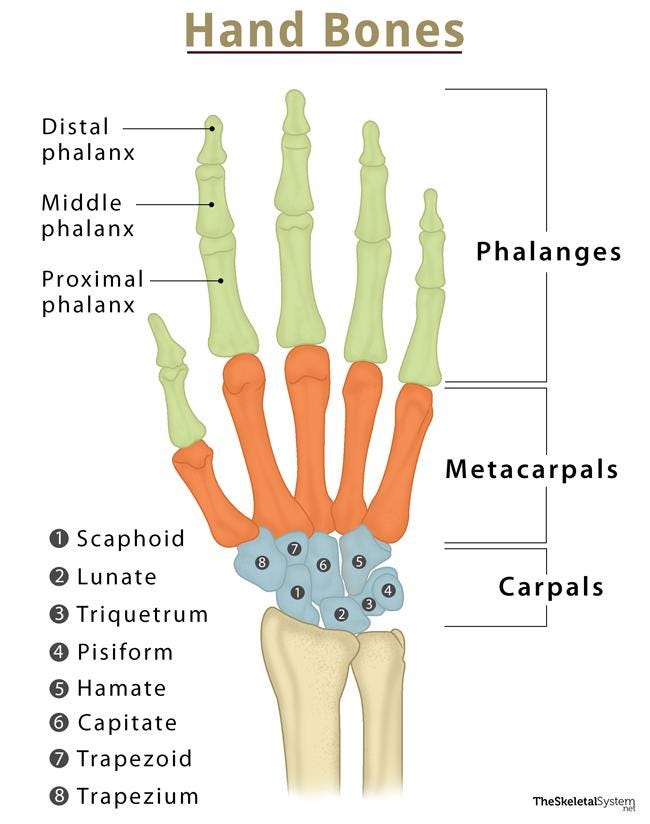
I count the phalanges and metacarpals, and just one of the carpals (the trapezium, if you must know). I do this while we are watching whatever’s on the screen. I count the four bones in the fingers and say to myself “Four time four is 16, and two hands, so that’s 32.” Then I count the three bones of the thumb and add the trapezium making another 4, or another 8 in total with both hands, and I say to myself “That makes 40.” It’s a nice round number. I have no idea why I do this, but I do it pretty much every day, and I like it.
A few minutes before writing this, I learned (because I looked it up) that such behavior is often diagnosed as a feature of Obsessive-Compulsive Disorder (OCD). Maybe it is, but I have no desire to stop doing it. This kind of counting is also known as arithmomania, which sounds like a dance move you are likely to be treated for if a forensic psychologist spots you doing it. Don’t you love the way medical terms disguise their judgment, “arithmo-“ from counting and “mania” from madness. If I’d been born later, I’m sure I’d have been diagnosed with all kinds of mental abnormalities. Fortunately I missed the era of such labelling and simply had to get on in a life where nobody cared or noticed I counted.
Our house is full of small rugs I walk on daily. I often walk across them by placing one foot in front of the other, and I count how many feet this is in total. I just measured my foot, and it’s ten inches long, so it’s easy to add up the total inches. Most of our rugs are four or five feet long, by which I mean my feet and therefore 40 or 50 inches—not the official foot-length of twelve inches. After I measured my foot, I measured my walking boots. They are twelve inches long—a proper foot. The twelve-inch foot measure we use today goes back to the Romans and their duodecimal system where lengths and time intervals were divisible by twelve. But I digress.
I have another counting habit. I only crops up when I’m waiting for an appointment. Maybe I’m anxious. If so, it may be OCD. Maybe, I’m bored. In which case it isn’t OCD. In 1970, I applied to go to university and was invited to an interview at the University of Leeds. I was nervous, waiting in the lounge of the Philosophy Department. I was waiting to speak with Dr. Hugo Meynell. The departmental secretary handed me a copy of their undergraduate brochure, outlining the range of subjects they taught and the names of the faculty.
The words swam across the pages. I started counting things in the room: three sofas, five chairs, four bookcases, four windows. Instead of reading the brochure, I counted the number of questions there were in the text.
Dr. Meynell proved to be warm and friendly. He told me he taught the philosophy of religion course and, if I got in, he would be teaching me in the coming term. We discussed my train journey from Leicester to Leeds, and he was concerned I not miss the return train. To end our conversation, he asked what I had made of the departmental brochure, and I said, “It contains thirty-two questions.” He said, “That’s great. Really, thirty-two? I had no idea.” He added, “I think we can offer you a place.” That moment changed the course of my life.
_________________________________
Story
I have come up with a new thought about writing when you use your own material as a source. Laurie posted this on her recent stack because I didn’t feel like it until now.
In a notebook, I wrote:
I recently wrote a story about a time in my twenties when I lived in a crummy flat in Birmingham. It was about the odd Irish couple I rented from. I posted it on Substack and a few days later I got an email from my ex-wife (of that period), asking why she’d been written out of the story.
In the story I was telling, there wasn’t a significant role for her. In fact, I wrote it as if I was a single person, intently watching my eccentric landlords. The email made me think about the process of writing. My ex-wife was assuming I was telling a story about my life as it had been, with some sort of factual base. To me, I was writing, not reliving my life.
I didn’t write her out. I had never written her in. For my ex-wife, the story had already happened, and I was recording it. For me, the story was something I was inventing in the moment of stringing sentences together. This difference in understanding is probably at the tangled root of many hurt feelings, pointless conversations, and wasted shrink sessions. Stories can’t write someone out, but if you write them in, you should be very careful about what you say.
Laurie is taken by the concept: You can’t write anyone out of a story because they only get to be there if you write them in.
____________________________________
Thanks for your support!
Thanks so much to the subscribers who are paying for this publication. It’s true, you don’t have to pay to read it because I want to attract the largest and most varied population of readers I can. You don’t have to pay to read the stack, but if you enjoy it, value it, and have not yet taken a turn at support, please consider making today the day you jump in.
You are the only funding source for this work, and there’s a discount for new subscribers and gift subscriptions. Make sure to use a browser on your phone or computer, and not the Substack app.
Please “like,” “comment,” and “share” this post. It helps the algorithm recognize me and connects me where I need to be!
fascinating you’re able to keep count while simultaneously staying focused (i assume) on whatever it is you’re watching! i suppose since it’s a longtime habit, by now the counting is almost unconscious, more an enactment of pattern? as i wrote on laurie’s post, i really love your distinction btwn writing vs. reliving. it ties into what she’s always saying about the danger of writing from memory, which is the temptation to remember and record, something of interest only to the one remembering.
I’m taken by the way you describe the distinction between reporting a story that had already happened and creating a story in the moment.